Showing posts with label costume drama. Show all posts

October 09, 2011

A Suitably English Excursion, Part 2

I'm not a great fan of big cities; small places tend to have more character - and are also better for day-trips. England in particular is full of little gems that most tourists tend to overlook. Nantwich, for example.
The town certainly isn't the most happening place in the world - when I went there, it was a market day, and the high street was full of old ladies. This, however, only added to the olde-worlde charm of the place. The town musem, on the other hand, was full of noisy schoolchildren, who were apparently there to learn about the traditions of cheese-making.
I found my way to the canal completely by accident, and spent a couple of hours following random footpaths back to the town centre. The weather was magnificent, and I really envied the people who floated by on their canal boats, smiling and waving as they went.
The locals were friendly as well, if a bit curious.
The following day I took a train to Knutsford - another charming old Cheshire town. Nowadays it's perhaps best known as Elizabeth Gaskell's Cranford (although Wikipedia tells me that the recent series was actually filmed in Wiltshire). Being more of a Brontë fangirl myself, my reason for going there was the town's main point of interest, Tatton Park.
Altough I'd done some research beforehand, I really wasn't prepared for the sheer size of the place. The park itself is HUGE: it took me almost an hour to make my way to the mansion.
Within the park, there were several big gardens, all of which were very impressive. Above the Italian garden behind the big house.
The Japanese garden, however, was my favourite. 
  I've seen quite a few historic houses in my time, but Tatton Park still managed to impress me. Also, five hours wasn't nearly enough to see everything; I would have liked to see the old Tudor hall, and to spend more time just walking around the park in the company of the deer and the sheep. Knutsford itself was a pleasant-looking place, and certainly worth more than a quick walk-through.

Still to come: A Suitably English Excursion, Pt. 3: The Wonders of Shrewsbury.

May 14, 2011

Alive and Flapping


As I predicted, it's been rather quiet here for a couple of months. With the third SHS party only a few weeks away, it's time to get back in the blogging business - and what better way to do it than by looking at some lovely ladies from the 1920s. 

Louise Brooks (above, click to enlarge) is by far one of my favourites flappers; there is something very elegant and at the same time something very outrageous about her. 


I don't know all that much about Evelyn Brent, but I like her hat, and her haughty expression. Wikipedia tells me that Brent was at one time married to Harry Fox, who gave his name to foxtrot. Live and learn. 


Norma Talmadge was a superstar of the silent film era. I love her dress and the pearls. 


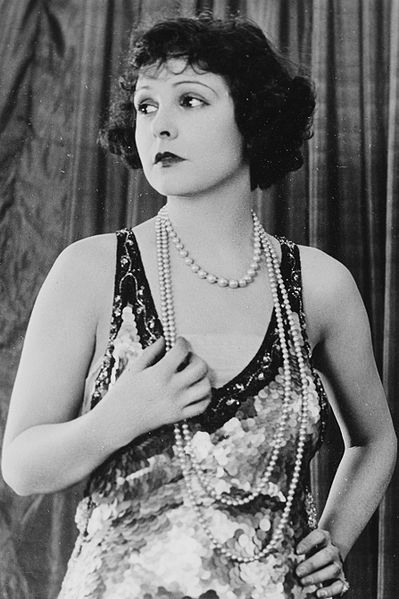
I don't know who this girl is, but there is something captivating about the simple elegance of the photograph. Makes me wish I had shorter hair so that I could try to duplicate that do.


Mary Eaton was a popular dancer and actress, who appeared alongside the Marx Brothers in The Cocoanuts...

 ...as did the Brox Sisters.


Fanny Brice was a comedienne, and later an inspiration for Funny Girl.


Karla Gutchrlein was one half of the Sisters G - and incredibly cool. 


Josephine Baker didn't believe in wearing very much, but she also lived a fascinating life. Bring on the banana miniskirt!

And finally, a reminder that although not all 20s women were young and glamorous, they sure knew how to have a good time. If I didn't already have suitably jazzy shoes for our speakeasy party, I'd be seriously considering a pair of boots big enough to slip a bottle of whisky in.

(Source: All pictures are from Wikimedia Commons)

March 06, 2011

Hiatus, and a Hat


It's been rather quiet here recently, and probably will be rather quiet for some time yet - at least until I've ploughed through the pile of work I'm under right now, and had a proper holiday. 

But until then, you can admire my new spring hat, which I trimmed yesterday and am rather proud of. The hat itself cost 2 euros, and was much uglier with a wide, turn-up rim. So I took my scissors, some ribbon I've had in my cupboard for about ten years now, and a few bits and bobs I've been saving for a project like this - and voilá: a 20's style cloche hat. 

I know Bessie Smith preferred much more outrageous headwear (notably the one which looks like a lampshade), but as she's my favourite 20's blues singer, I'll let her accompany my new hat. 

December 09, 2010

The wonders of the west coast


It's been a busy past few weeks. In addition to trying to finish my PhD, I've also been teaching a couple of courses - one of them some 400 kms from where I live. It was great fun, though, to get an opportunity to take a train to a completely unknown city, stay the night at a fine hotel, talk about literature to  bunch of motivated students, and spend the rest of the time walking around the old part of the city with my mouth hanging slightly open. I hadn't quite realised the Neristan in  Kokkola was quite as amazing as that.

Unfortunately, my camera froze on me (again), so I got very few pictures that are actually in focus. Perhaps better this way - otherwise I would have snapped photos of each and every house and perhaps embarrassed myself in the process. 

Looking forward to going back in January. Then I'm planning to finally lay eyes on the famous gunboat which was captured from the British during the Crimean war, and which the brits have been very eager to get back ever since.  SHS is already planning a re-enactment of the impressive battle in which such a prize landed in Finnish hands.

November 15, 2010

Getting rather silly


Today the sun manages to stay over the horizon for seven hours and a bit. Despite the snow, days are desperately grey, and everything kind of blurs. It's hard to keep track of deadlines, or even remember if I've managed to do anything worthwhile lately.

In addition to teaching and trying to finish my PhD there isn't all that much going on at the moment - but at least I've had some interesting dreams lately (even compared to my usual standard). Last night, for instance, listening to the constant drip-drop of water outside my window, I finally managed to fall asleep and grew convinced that there was only one person who could explain the meaning and the source of the noise: Samuel Pepys.

I believe this history lark is really beginning to mess with my head. In the nicest possible way. Just like this song.


That is all.

September 15, 2010

The fruits of 22 labours


It's been some time since I've written any kind of a book report here. Let me amend that lapse now. I know that's what you're all have been clamouring for at the backs of your minds, without really even knowing it. 

I won't go through all the historical books I read last summer - for after checking my reading diary I noticed that there is quite a number of them, most dealing with the Austen/Napoleon period, most appropriately. The memory of most of those, however, has now been blocked by Wolf Hall - which I'm reading now, and which is every bit as fantastic as they say it is. The (perhaps only) problem with a book of that stature is that it tends to overshadow everything else I'm reading at the time, diluting the pleasure of other books by reminding just how good prose can get. 

Fortunately Wolf Hall is facing some fierce competition; one of the books I read about a month ago refuses to be blotted out by another. I'm talking about Stella Tillyard's Aristocrats, a real-life story of four Lennox sisters whose lives spanned the latter part of the 18th century. The book has been made into a TV series, and that's how I first became aware of  the lives  of these quite amazing women some years ago. The splendour of the setting is one thing (after all, Caroline, Emily, Louisa and Sarah Lennox were aristocrats born and bred, and wed into well-connected and wealthy families), but what strikes me most is the sheer tenacity of the Lennox women and their strong mutual affection and loyalty, which must have carried them through some hard times.

I mean, if you've given birth to 22 children (like Emily did), you'll be mighty glad of some family support. 

Tudor times were also an era when family connections paid off; this at least was emphasised in Philippa Gregory's The Other Boleyn Girl.  I really liked the novel, especially Gregory's effortless depiction of Renaissance England and the court of Henry VIII, as well as her frank descriptions of the ribaldries that went on there. Placing Mary Boleyn in the centre of the story (instead of her more illustrious sister) is a good choice, as it gives the plot an element of suspense (after all, we all know what happened to Anne Boleyn). Yet I was somewhat disappointed in the rather straightforward solution of making Anne the scheming shrew and Mary the motherly lady-in-waiting who is all heart and loving tenderness. The Career Woman vs. the Mother debate in a nutshell = one gets her head chopped off, another gets to settle down with a good man of her choice.

Another book which gave me some ambivalent feelings is Mrs Caliban and Other Stories by Rachel Ingalls, which I just finished. I liked the slightly twisted starting points of the stories (including people being kidnapped by grannies in Switzerland, cheating their wives with a lifelike doll, or getting caught in a rain of frogs), but their solutions were depressingly rather similar. Most of the men (boyfriends, husbands, bosses) were portrayed as heartless bastards who only use women for their own gratification and start slapping them around when they show some character. That may work well to illustrate an important point in one novel, but after seven or eight of the same, the reader (or at least I) begins to feel the need of some more life-affirming stuff. 

Perhaps that's why I've been listening to a lot of Monty Python lately.

July 28, 2010

This is just to say...

  I have eaten
the plums
that were in
the icebox

and which
you were probably
saving
for breakfast

Forgive me
they were delicious
so sweet
and so cold 


                          (William Carlos Williams) 


...and that the Austen/Napoleon party went brilliantly.

... that it's still sweltering hot, and I'm still enjoying it.

... and also that I have a new groovy tablecloth. 


That is all.

July 10, 2010

Another party, another pie


A week from now, another SHS party will (hopefully) be in full swing. So far, the preparations have gone without a hitch: our dresses are coming along nicely (thanks to Juska's unflagging effort), most people who've promised to come are probably going to turn up, and most importantly, the menu is looking good. At least for the most part.

The one thing that has been causing me some brief moments of anxiety is the vegetarian option. As far as I know, all of our guests are meat-eaters, but it's always best to be prepared; also, an extra dish never goes amiss especially as the party's going to be an all-night one. 

Following the tradition established last year, we (Otter and I) decided that some kind of vegetable pie will do this job nicely. The Renaissance version was delicious; in fact, I'm so fond of the cheese-and-onion tart that I make it on a regular basis. Thus I was confident that the Regency era would yield something equally tasty. But I was wrong. Most of the pies I've come across are either very simple (and thus not very festive) carrot-leek-parsnip-cabbage affairs - or else they have bacon in them. The time of Jane Austen doesn't appear to be very  vegetarian-friendly. Another explanation for the dearth of suitable recipes is that there are tons of websites dedicated to Middle Ages/Renaissace cooking, and a lot fewer specialising in the short and apparently rather uninteresting era between the French Revolution and the Victorians.


Luckily, with a lot of googling, I finally came across a recipe that's both authentic and pork-free.  Actually, the version I made is a combination of two different tarts, which have the same basic idea: cheese, eggs, spices + something green. I chose a mixture of nettles and herbs, which works quite well, but I'm not yet completely satisfied with the result. At least straight from the oven the taste is rather bitter (despite the sugar), and now I'm trying to figure out how to sweeten it. Adding raisins would be an option, but as there are currants and sultanas in the desserts, I think there is a possibility of dried grape overload. Perhaps a different type of cheese would solve the problem.

Well, I'm going north for the next few days, which both gives me the opportunity to get away from this mind-paralysing heat, and also to pick my mother's brain regarding the pie dilemma. I'm sure she'll have some constructive ideas.  

In addition to puzzling out the party menu, today I've also tried to figure out how to do my hair. The basic idea has been quite clear to me for several months, and I've tried different approahces, but finally I've hit on the perfect solution. The curly Greek do has the advantage that although it takes almost an hour to get the pin curls done (and a whole night to let them to their job), the bun itself is ridiculously simple to construct, and with the right amount of hair spray (which I'm sure Miss Austen would have heartily approved of) stays in place for hours and hours.


The picture makes the do look duller than it is IRL (I'm rubbish at taking pictures of myself, and my camera certainly doesn't make the job any easier), but at least I've managed to hold a suitably haughty stance. Which will come in useful when I'm dressed in my purple coronation gown. No Lizzie Bennet bonnets for me - when I do costume drama, I go straight for the royalty. ;)

May 23, 2010

Heroines of their own lives


As I've mentioned in some posts before, my usual method of finding something new to read is to wander around in a library and randomly pick up volumes that look interesting; so you could say that I rely on the judging-a-book-by-its-cover method. Of course this doesn't just mean choosing books which have eye-catching covers (although this also happens frequently); it can be the title, or the blurb, or the name of the writer (familiar or not) which attracts me enough to take the whole book home with me. 

This method rarely fails, and I've discovered many of my favourite writers this way. The last gem which attracted my eye did so by its gorgeous green cover, which contrasted intriguingly with its title, The Yellow House. On closer inspection the work (written by an Irish-American called Patricia Falvey) turned out to be a story of a woman growing up in the trouble-ridden Northern Ireland around the turn of the 20th century. What hooked me about this book was, along with its glistening language, the sheer personal charm of its protagonist, Eileen O'Neill. Rarely have I come across such a self-assured, dynamic, and yet sensitive leading character, who remains thoroughly credible all through the text. 

About the only scruple I had with The Yellow House was its somewhat predictably hurried happy ending. Yet the force of the narrative was such that I didn't find it very hard to accept this solution, and my sympathy for Eileen was so strong that I sincerely wished her well. Which is again quite rare in my reading experience. 

And which is something I couldn't grant to the leading lady of another book I've just finished. This time it was the orange Penguin back which attracted my eye, along with the matter-of-fact title, Lady's Maid, by Margaret Forster. The name of the writer rang a bell, and as the book announced it told the story of the household of Elizabeth Barrett Browning, I couldn't put it back on the shelf with a good conscience. 

Now, I'm a sucker for most things to do with Victorian England,  and especially with its writers. I expected this book to open a new, edifying window into the lives of Elizabeth and Robert Browning, as well as providing some good page-turning narrative from the point of view of their maid, Wilson. I profess myself disappointed, however: all of the characters of the tome (over 500 pages of it) - including the protagonist - turned out to be rather flat, and move about in their period setting like so many paper dolls.  Although the semi-fictional setting provides lots of interesting events, none of these really touch the reader - as they don't seem to touch the wooden Wilson or to give any real insight into her character.  There are no real climaxes in the narrative; even the death of Elizabeth is rather an anti-climax, as it only releases her maid to a life of empty resignation.

Basically, the problem for me is that there are no likeable characters in the novel, or indeed any characters which arouse any strong emotions at all. Wilson, despite her efforts, never really learns to understand her own feelings, and thus also leaves the reader high and dry. Her mistress is a selfish invalid, and her husband only flits in the periphery of the story, in turns sympathetic or cold towards his wife's servant/friend. Wilson doesn't have real friends, and the numerous men she tries to love all turn out to be either complete bastards or just very very dull people.

Doing some post-reading research, I discovered that Wilson was also a real person, and that her life went on for decades after the end of the narrative of Lady's Maid. Forster, in her afterword, also acknowleges this, and flashes the possibility of a sequel. In my view, with some well-judged condensation, all of this material could have been included in Maid as it would have at least provided a more satisfactory ending.

All in all, when it comes to the Brownings, I much prefer this version of their story.

Talking of women and fiction, in case you're wondering, the woman in the above picture is my paternal grandmother, Amanda, who died in 1963. As I never stood the remotest chance of meeting her, over the years I've created many versions of her story. The facts I possess are scanty, which gives me even more liberty to imagine what her personality, wishes, accomplishments were like - and whether we would have got along.

Perhaps it's for the best not to know - but that never stops the imagination.

Anyway, here's some very lovely music: 


May 09, 2010

And did those teeth in ancient times...


The weather's been most uninspiring for the past week or so, and I can't say that spring in general agrees with me. All that light and slush and birdsong just makes me restless - which doesn't bode well for the PhD.  Motivation seems to have jumped out of the window, and at the moment sitting still and writing a few coherent sentences now and again is all I can manage - just barely. 

A part of me is already frolicking in the old Green and Pleasant (where Otter, T, and Otter's brother - another T - and myself are headed next month). The pessimist in me tries to put a damper on things by suggesting that perhaps we haven't yet seen the end of Icelandic smoke and ash - and many volcanoes can erupt in the next three weeks. Yet the thought of all those full English breakfasts, pints of bitter, lovely Devon countryside, and perhaps even the moderately lovely city of Bath (which didn't impress me on my first visit - but I'm willing to give it another go) keeps me going, despite the cold weather and academic underachievement. 

Talking about achievement - here's something that has been making its rounds in the feminist blogosphere over the weekend, and made my day yesterday. Behold the power of the Brontë sisters: 


I wish I'd had a Brontësaurus when I was growing up, instead of a Barbie. Then again, Barbies could do some kick-ass stuff as well, even though they didn't come with those amazing moustaches.

April 24, 2010

Confessions of a Rosewater Eater


Rosewater is not a staple spice in traditional (or even in the contemporary, more cross-culinary) Finnish cooking; therefore it took me a long while to realise it had such a wide range of uses. In this country, liquids that smell of rose are usually reserved for cosmetic purposes, which is a shame. 

As I happen to have a bottle of rosewater in my fridge, I've been looking for new foods to put it in. Yesterday I came across a mention of medieval rosewater wafers, which were enjoyed at most festive occasions. Because of the wonders of the internet, I was able to find a recipe (here) and with some alterations, came up with the beauties pictured above. The main difference was that I didn't use a wafer iron, but a frying pan  - just like when making contemporary pancakes. 


My love affair with rose water officially began about a year ago, when Otter and I got the wonderful idea of trying out milk jelly according to an authentic Tudor recipe (as documented here).  Although the gentle aroma of the slippery cubes didn't appeal to everyone, at least they were unlike anything we'd ever  tasted before. Thus they were served as "second dessert" at our Renaissance party, along with lovely fruit and some anachronistic coffee, and if not universally adored, at least got sampled by all of our  brave guests.

(The photo above courtesy of this guy who unfortunately isn't a fan of the white wobbly stuff.)


The preparations for next summer's period frock party have already begun, and one manifestation thereof can be seen above. Those are  Rout Drop Cakes, the recipe for which I found in The Jane Austen Cookbook (by Maggie Black and Deirdre le Faye). Otter and I tried them out over the Easter holidays - and they were delicious, simply melting in the mouth. There's plenty of rosewater in them, but also some brandy, orange juice, currants and lots of sugar. 

It says in the book that these little cakes "are pleasant with a glass of wine or a cup of coffee." Having tried them with both, I can assure that they are indeed.

March 23, 2010

Amused, I'm sure


Recently I've spent a considerable amount of time combing through the intertubes in search of Regency (or Austenian, or empire - whichever you prefer) inspiration. Mainly the pictures and articles I've come across have been quite ordinary - dealing with spencers and pelisses and different hairstyles and chicken Napoleon - but there have been some eye-openers as well. 

Now, most of us associate the era of Jane Austen with genteel manners, dainty ladies and dashing gentlemen. Lots of these about, naturally, as well - but the Regency era, as well as the one preceeding it, could be a pretty boisterous place to be. Unlike the furtive Victorians, these people could and did flaunt their stuff in the broad daylight - and also laugh about it. I've previously mentioned my love of James Gillray's satirical pictures: now I've discovered that he wasn't the only one making delicious caricatures at the turn of the 19th century. I should have known better, really. 

Most of the pictures here come from this meticulously assembled website. Click if you want to see a larger version.

First, a look at the wonderful fashions of the day: 


This one's called "Les Invisibles en Tête-à-Tête". It just struck me that a fashion like that could be really useful today - you could use your mobile inside one of those hats, while on a bus for instance, without disturbing anyone. I bet a really enterprising lady could assemble a whole office into a hat like that.

The next one illustrates the fact that heterosexuality wasn't the only option for well-bred ladies even in the old days: 
 

Notice the two men lurking together in the bushes as well. And, finally, proof that even then, ladies were dying to find the answer to the ages-old question: 
 
 
I bet he wasn't.


March 05, 2010

Nil significat, nisi oscillat


I'm heading South for the weekend, to partake of some jazz and good company.  Now that the sun is out, there's an air of spring about it, too.

I've been asked to sing a few numbers at the party; I don't usually do jazz, so it's been a bit of a challenge to find suitable songs, but it's been a lot of fun practicing as well. I'll never be able to do a piano solo like Nina Simone - but then again, no one can.


February 28, 2010

Art, For Art's Sake!


This year's hibernation is finally coming to an end, at least when it comes to sampling bits and pieces of art and culture. Yesterday was really hyper-active in that department, and it looks like next week will be quite busy as well. Which suits me just fine. 

Yesterday Juzka and I set out to find how much popular culture one can find and consume within an evening; as it turns out, quite a lot. First, we went to the cinema to check out the latest Disney flick. I've never been an ardent fan of that particular genre, but as far as predictable and visually pleasing fairy-tales go, The Princess and the Frog was fairly enjoyable.  I especially liked the music (composed by none other than Randy Newman).  I'm actually listening to the soundtrack right now (bless you, Spotify!) - and I can say that the original versions are even more jazzy than the Finnish ones (although they weren't un-groovy either). 

After the film, we had some lovely soup and pasta and wine at Soppabaari (one of my favourite restaurants), and then headed for the theatre to see The Crucible.

I can't pretend that I was aware of the work before (although as a former English major I probably should have been) - and the only thing I knew about the play before seeing it was that it dealt with the Salem witchcraft trials. So at least you can say that I wasn't exactly expecting a comedy. And comedic it certainly wasn't; instead, there were shrieking women, selfish judges, witchcraft (real and imagined), deception, false accusations and death aplenty. Lovely.

Basically I liked the play; most of the characters were well cast, and the actors embraced the chaotic atmoshphere of 17th century Salem convincingly. The only major thing that hindered my enjoyment were the ridiculous and illogical costumes. Some characters were dressed in more or less accurate period clothes, others looked like they'd been imported from Victorian England - and the rest had apparently thrown on any black-and-white garments they'd happened upon (black and white being the thematic colours). 

The greatest sartorial faux-pas, however, was the ridiculous waist-length black wig worn by the Deputy Governor, with strange curly bits on top, which made him look like a cross between a Goth and a badly permed granny. But perhaps that was the whole idea.

Finally Juzka and I ended up in a pub, listening to a mediocre U2 cover band. We did manage to make some serious plans for empire dresses, though, which was good. 

Oh, and here's a thing I just have to share with you. This song never fails to tickle my anachronistic fancy: